

Gas Boiler Installation Cardiff: What Current Rules Mean for Homeowners
Understand the latest gas boiler installation requirements in Cardiff, including safety regulations, flue suitability and essential commissioning checks.

Why you can trust our content
We understand that the boiler industry can be confusing, with plenty of outdated or misleading information. That’s why we rely only on trusted, proven sources to guide our advice and installations:

At a glance
Replacing a gas boiler is more than choosing a new appliance and arranging an installation date. Gas appliances, flues, ventilation, controls and associated heating components all need to be considered as part of the installation.
For Cardiff homeowners, this can become confusing when discussions about future heating policy are added to the mix. Headlines about gas boilers, energy efficiency and future heating systems can make it difficult to understand what actually matters when replacing a boiler today.
The practical approach is to focus on the requirements that apply to the installation, the condition of the existing system and whether the proposed replacement is suitable for the property.
What rules apply when installing a gas boiler?
A gas boiler installation must meet applicable safety and building requirements. Gas work should be carried out by an appropriately qualified and registered professional, with the installation completed and commissioned correctly.
The precise requirements can depend on the property and the work being carried out.
Important areas can include:
- Safe connection to the gas supply
- Appropriate flue installation
- Adequate ventilation where required
- Suitable condensate arrangements
- Correct heating and hot water connections
- Appropriate controls
- Safe commissioning and testing
- Compliance with relevant building requirements
The installer should also provide the homeowner with the relevant documentation following completion.
For homeowners arranging gas boiler installation in Cardiff, this is why the installer matters as much as the appliance itself.
Does replacing an existing boiler require the same checks as a new installation?
A replacement can sometimes be relatively straightforward, particularly when the new boiler is installed in the same position as the old one.
However, the installer still needs to assess the existing arrangement. The fact that a previous boiler occupied a particular location does not automatically mean the new installation can simply copy everything that was there before.
The flue, pipework, gas supply, condensate arrangements and controls may need to be checked. Changes may also be necessary where current requirements differ from those that applied when the original boiler was installed.
This assessment is an important part of a proper replacement.
If you are planning a boiler replacement, contact the MPH team to discuss your existing system and the installation requirements for your property.
What should homeowners check before booking a gas boiler installation?
Before agreeing to an installation, it is useful to understand what the quotation actually covers.
A professional quotation should give you a reasonable explanation of the proposed appliance and the work required to install it.
Consider asking:
- Which boiler model is being recommended?
- Why is its output suitable for the property?
- Will the existing pipework be suitable?
- Does the flue need to be altered?
- Are new controls included?
- What happens to the old boiler?
- Is commissioning included?
- What warranty arrangements apply?
- Are there any additional works that may affect the final price?
A clear quotation can prevent misunderstandings later.
Let’s get started, Which fuel powers your boiler?
Mains Gas
LPG
It just takes 60 Sec
And then you can book a free consultation
Why does the installation location matter?
Where the boiler is installed can affect both the practical work and the final cost.
Replacing a boiler in the same position may involve fewer alterations than moving it to another room or part of the property. Moving the appliance can require additional pipework, changes to the flue route and alterations to condensate drainage.
The available space also needs to be considered. A modern appliance may have different dimensions from the existing boiler, so an installer should check that the proposed location is appropriate.
In some homes, the homeowner may also want the boiler moved to create additional cupboard or living space. This can be possible, but it should be assessed before a quotation is finalised.
What does a gas boiler installation company actually need to assess?
A competent gas boiler installation company should consider the complete heating arrangement rather than treating the boiler as an isolated appliance.
The assessment can include:
| Area checked | Why it matters |
| Existing boiler | Establishes the starting point |
| Gas supply | Ensures the appliance can operate correctly |
| Pipework | May need upgrading or alteration |
| Flue | Must be suitable for the replacement appliance |
| Condensate | Needs an appropriate drainage arrangement |
| Heating system | Helps establish compatibility |
| Hot water demand | Influences boiler and system selection |
| Controls | Affect heating management and efficiency |
| Boiler location | Determines practical installation requirements |
This does not mean every installation will require extensive changes. A good assessment establishes what is actually needed.
Do current rules mean homeowners should avoid gas boilers?
Not automatically.
Gas heating policy is changing, and lower-carbon technologies are becoming increasingly important. However, that does not mean every existing property is currently required to abandon gas heating.
A homeowner replacing an existing boiler should consider the rules that apply at the time of installation and the suitability of the heating system for the property.
It is also useful to distinguish between long-term policy objectives and immediate legal requirements. A future ambition to reduce fossil fuel use is not the same thing as a rule requiring every current homeowner to replace a functioning gas boiler.
If you are unsure how current heating requirements affect your replacement plans, speak to MPH for straightforward, property-specific guidance.
What about boiler efficiency requirements?
Modern boilers are designed around higher efficiency standards than many older appliances.
A replacement boiler should be selected and installed according to the requirements applicable at the time. Controls can also form an important part of the overall system because they allow homeowners to manage heating more precisely.
However, efficiency is not simply a specification printed on the appliance.
Installation quality, boiler sizing, system condition, heating controls and the way the home is used can all influence real-world performance.
A correctly installed boiler that is appropriately sized for the property is generally more useful than simply choosing a model with the highest available output.
Can an old boiler simply be repaired instead?
Sometimes.
If an existing boiler is safe and repairable, a repair may be entirely reasonable. Replacement becomes more relevant where the boiler is old, increasingly unreliable or repeatedly developing expensive faults.
Homeowners should consider the wider pattern rather than making a decision based on a single breakdown.
A relatively inexpensive repair may restore an otherwise dependable boiler. On the other hand, repeated repairs can indicate that replacement should at least be investigated.
This is particularly relevant where parts are becoming difficult to source, or the appliance no longer performs as efficiently as a modern replacement.
What happens during a professional boiler installation?
The exact process varies, but a typical replacement may involve several stages.
First, the existing system is assessed, and the old appliance is safely removed. The installer then prepares the installation area and connects the replacement boiler to the relevant gas, heating, water and electrical components.
The flue and condensate arrangements are checked, while any required controls are installed or updated. The system is then tested and commissioned.
The boiler should not simply be switched on and left running. Proper commissioning helps ensure that the appliance is operating correctly and safely.
For gas boiler installation in Cardiff, the quality of this process is an important consideration when comparing quotations.
What can make a boiler installation more complicated?
Several factors can increase installation complexity.
Examples include:
- Moving the boiler to a new location
- Altering the flue route
- Upgrading older pipework
- Changing from one boiler type to another
- Modifying heating controls
- Addressing unsuitable condensate drainage
- Working within difficult access areas
- Identifying problems with the existing heating system
None of these automatically means an installation will be unsuitable. They simply demonstrate why a proper survey can be more useful than an online price alone.
A typical Cardiff replacement example
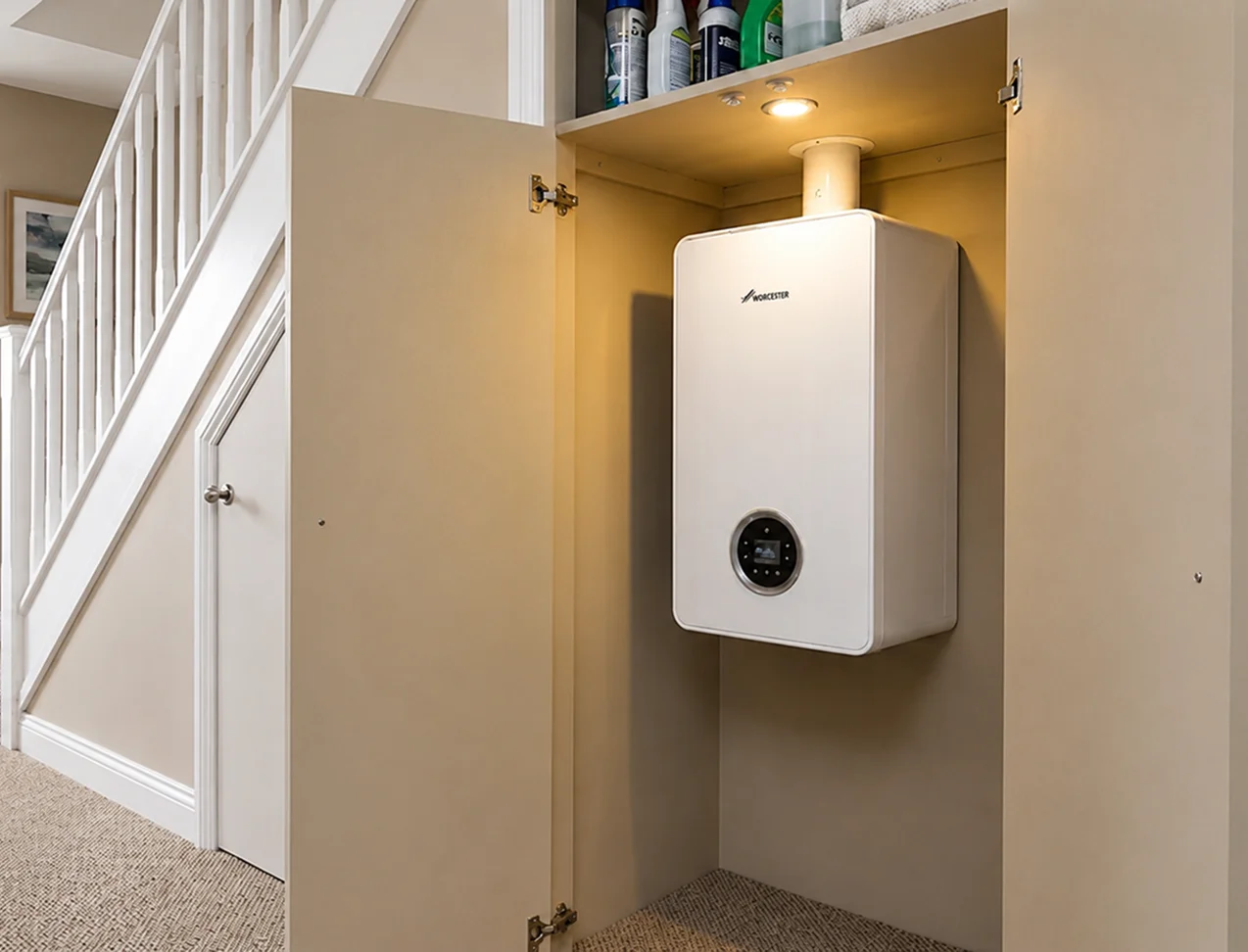
Imagine a homeowner with an older boiler installed in a kitchen cupboard. The appliance has become unreliable, but the existing heating system otherwise works well.
During an assessment, the installer determines that a modern replacement can remain in the same general location. The existing pipework is checked, the flue arrangement is assessed, and the controls are reviewed.
Because the work is planned rather than carried out during an emergency, the homeowner has time to understand the proposed installation and ask questions before agreeing to the work.
That is a useful example of why installation planning matters. The aim is not to make every project complicated, but to identify the requirements before work begins.
How should you choose an installer?
Look for an installer who can explain the proposed work clearly and answer practical questions about the installation.
A suitable gas boiler installation company should be transparent about what is included, identify any additional work that may be required and provide appropriate documentation after completion.
Be cautious of quotations that provide little information beyond the boiler brand and a single price. Two installations that appear similar on paper can involve different amounts of work.
The quality of the installation can have a direct bearing on safety, reliability and how effectively the heating system operates.
What should Cardiff homeowners focus on?
Current heating policy does not mean homeowners should panic about replacing a gas boiler. Instead, focus on the rules and requirements that apply to the installation you are actually planning.
A safe replacement involves more than selecting a boiler. Gas supply, flue arrangements, pipework, controls, condensate drainage, commissioning and the suitability of the appliance all need to be considered.
If your existing boiler is unreliable or approaching the end of its useful life, planning ahead can give you time to compare options without the pressure of an emergency breakdown.
MPH can help Cardiff homeowners understand their boiler replacement options and the installation work required. Contact our team for tailored advice and a bespoke quotation.
Related articles
Let’s get started, Which fuel powers your boiler?
Mains Gas
LPG
At a glance
Replacing a gas boiler is more than choosing a new appliance and arranging an installation date. Gas appliances, flues, ventilation, controls and associated heating components all need to be considered as part of the installation.
For Cardiff homeowners, this can become confusing when discussions about future heating policy are added to the mix. Headlines about gas boilers, energy efficiency and future heating systems can make it difficult to understand what actually matters when replacing a boiler today.
The practical approach is to focus on the requirements that apply to the installation, the condition of the existing system and whether the proposed replacement is suitable for the property.
What rules apply when installing a gas boiler?
A gas boiler installation must meet applicable safety and building requirements. Gas work should be carried out by an appropriately qualified and registered professional, with the installation completed and commissioned correctly.
The precise requirements can depend on the property and the work being carried out.
Important areas can include:
- Safe connection to the gas supply
- Appropriate flue installation
- Adequate ventilation where required
- Suitable condensate arrangements
- Correct heating and hot water connections
- Appropriate controls
- Safe commissioning and testing
- Compliance with relevant building requirements
The installer should also provide the homeowner with the relevant documentation following completion.
For homeowners arranging gas boiler installation in Cardiff, this is why the installer matters as much as the appliance itself.
Does replacing an existing boiler require the same checks as a new installation?
A replacement can sometimes be relatively straightforward, particularly when the new boiler is installed in the same position as the old one.
However, the installer still needs to assess the existing arrangement. The fact that a previous boiler occupied a particular location does not automatically mean the new installation can simply copy everything that was there before.
The flue, pipework, gas supply, condensate arrangements and controls may need to be checked. Changes may also be necessary where current requirements differ from those that applied when the original boiler was installed.
This assessment is an important part of a proper replacement.
If you are planning a boiler replacement, contact the MPH team to discuss your existing system and the installation requirements for your property.
What should homeowners check before booking a gas boiler installation?
Before agreeing to an installation, it is useful to understand what the quotation actually covers.
A professional quotation should give you a reasonable explanation of the proposed appliance and the work required to install it.
Consider asking:
- Which boiler model is being recommended?
- Why is its output suitable for the property?
- Will the existing pipework be suitable?
- Does the flue need to be altered?
- Are new controls included?
- What happens to the old boiler?
- Is commissioning included?
- What warranty arrangements apply?
- Are there any additional works that may affect the final price?
A clear quotation can prevent misunderstandings later.
Let’s get started, Which fuel powers your boiler?
Mains Gas
LPG
It just takes 60 Sec
And then you can book a free consultation
Why does the installation location matter?
Where the boiler is installed can affect both the practical work and the final cost.
Replacing a boiler in the same position may involve fewer alterations than moving it to another room or part of the property. Moving the appliance can require additional pipework, changes to the flue route and alterations to condensate drainage.
The available space also needs to be considered. A modern appliance may have different dimensions from the existing boiler, so an installer should check that the proposed location is appropriate.
In some homes, the homeowner may also want the boiler moved to create additional cupboard or living space. This can be possible, but it should be assessed before a quotation is finalised.
What does a gas boiler installation company actually need to assess?
A competent gas boiler installation company should consider the complete heating arrangement rather than treating the boiler as an isolated appliance.
The assessment can include:
| Area checked | Why it matters |
| Existing boiler | Establishes the starting point |
| Gas supply | Ensures the appliance can operate correctly |
| Pipework | May need upgrading or alteration |
| Flue | Must be suitable for the replacement appliance |
| Condensate | Needs an appropriate drainage arrangement |
| Heating system | Helps establish compatibility |
| Hot water demand | Influences boiler and system selection |
| Controls | Affect heating management and efficiency |
| Boiler location | Determines practical installation requirements |
This does not mean every installation will require extensive changes. A good assessment establishes what is actually needed.
Do current rules mean homeowners should avoid gas boilers?
Not automatically.
Gas heating policy is changing, and lower-carbon technologies are becoming increasingly important. However, that does not mean every existing property is currently required to abandon gas heating.
A homeowner replacing an existing boiler should consider the rules that apply at the time of installation and the suitability of the heating system for the property.
It is also useful to distinguish between long-term policy objectives and immediate legal requirements. A future ambition to reduce fossil fuel use is not the same thing as a rule requiring every current homeowner to replace a functioning gas boiler.
If you are unsure how current heating requirements affect your replacement plans, speak to MPH for straightforward, property-specific guidance.
What about boiler efficiency requirements?
Modern boilers are designed around higher efficiency standards than many older appliances.
A replacement boiler should be selected and installed according to the requirements applicable at the time. Controls can also form an important part of the overall system because they allow homeowners to manage heating more precisely.
However, efficiency is not simply a specification printed on the appliance.
Installation quality, boiler sizing, system condition, heating controls and the way the home is used can all influence real-world performance.
A correctly installed boiler that is appropriately sized for the property is generally more useful than simply choosing a model with the highest available output.
Can an old boiler simply be repaired instead?
Sometimes.
If an existing boiler is safe and repairable, a repair may be entirely reasonable. Replacement becomes more relevant where the boiler is old, increasingly unreliable or repeatedly developing expensive faults.
Homeowners should consider the wider pattern rather than making a decision based on a single breakdown.
A relatively inexpensive repair may restore an otherwise dependable boiler. On the other hand, repeated repairs can indicate that replacement should at least be investigated.
This is particularly relevant where parts are becoming difficult to source, or the appliance no longer performs as efficiently as a modern replacement.
What happens during a professional boiler installation?
The exact process varies, but a typical replacement may involve several stages.
First, the existing system is assessed, and the old appliance is safely removed. The installer then prepares the installation area and connects the replacement boiler to the relevant gas, heating, water and electrical components.
The flue and condensate arrangements are checked, while any required controls are installed or updated. The system is then tested and commissioned.
The boiler should not simply be switched on and left running. Proper commissioning helps ensure that the appliance is operating correctly and safely.
For gas boiler installation in Cardiff, the quality of this process is an important consideration when comparing quotations.
What can make a boiler installation more complicated?
Several factors can increase installation complexity.
Examples include:
- Moving the boiler to a new location
- Altering the flue route
- Upgrading older pipework
- Changing from one boiler type to another
- Modifying heating controls
- Addressing unsuitable condensate drainage
- Working within difficult access areas
- Identifying problems with the existing heating system
None of these automatically means an installation will be unsuitable. They simply demonstrate why a proper survey can be more useful than an online price alone.
A typical Cardiff replacement example
Imagine a homeowner with an older boiler installed in a kitchen cupboard. The appliance has become unreliable, but the existing heating system otherwise works well.
During an assessment, the installer determines that a modern replacement can remain in the same general location. The existing pipework is checked, the flue arrangement is assessed, and the controls are reviewed.
Because the work is planned rather than carried out during an emergency, the homeowner has time to understand the proposed installation and ask questions before agreeing to the work.
That is a useful example of why installation planning matters. The aim is not to make every project complicated, but to identify the requirements before work begins.
How should you choose an installer?
Look for an installer who can explain the proposed work clearly and answer practical questions about the installation.
A suitable gas boiler installation company should be transparent about what is included, identify any additional work that may be required and provide appropriate documentation after completion.
Be cautious of quotations that provide little information beyond the boiler brand and a single price. Two installations that appear similar on paper can involve different amounts of work.
The quality of the installation can have a direct bearing on safety, reliability and how effectively the heating system operates.
What should Cardiff homeowners focus on?
Current heating policy does not mean homeowners should panic about replacing a gas boiler. Instead, focus on the rules and requirements that apply to the installation you are actually planning.
A safe replacement involves more than selecting a boiler. Gas supply, flue arrangements, pipework, controls, condensate drainage, commissioning and the suitability of the appliance all need to be considered.
If your existing boiler is unreliable or approaching the end of its useful life, planning ahead can give you time to compare options without the pressure of an emergency breakdown.
MPH can help Cardiff homeowners understand their boiler replacement options and the installation work required. Contact our team for tailored advice and a bespoke quotation.
Related articles
Address
Office Location:
376 Newport Road
Cardiff
CF23 9AE
The content on this website is owned by us and our licensors. Do not copy the content (including images) without our consent.
MPH INSTALLATIONS LTD (MPH PLUMBING & HEATING) is an Introducer Appointed Representative (Financial Services Register No. 916214) of Phoenix Financial Consultants Limited (Phoenix). Phoenix is a credit broker, not a lender. Phoenix is authorised and regulated by the Financial Conduct Authority (FRN: 539195), and offers finance from its panel of lenders. All finance subject to status and credit checks.

Powered by We Build Trades © 2026
Amout of credit
£0.00
Monthly
£0.00
Total payable
£0.00
Interest (fixed)
£0.00
APR
-